
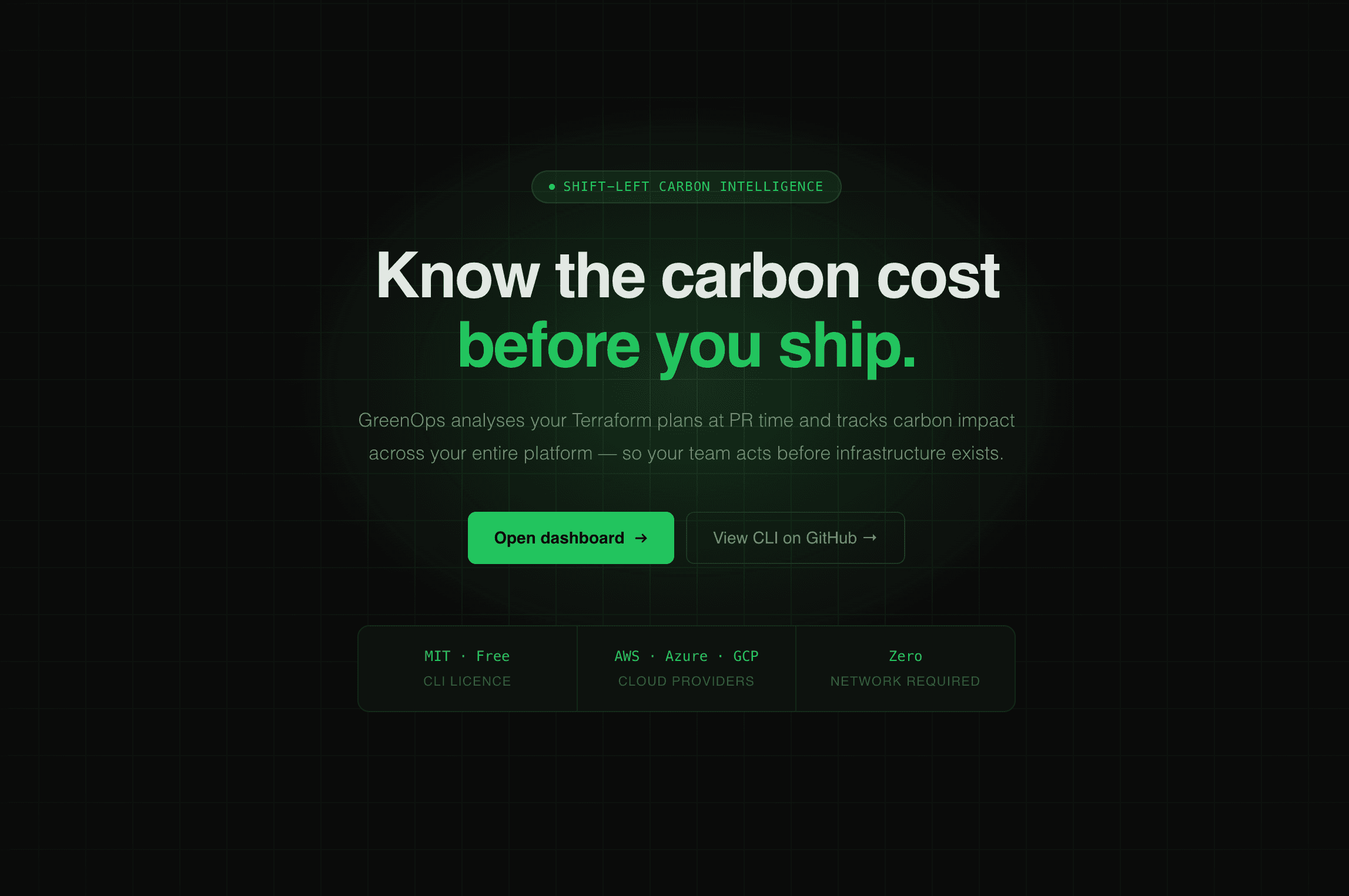
GreenOps CLI
An open-source Terraform carbon-footprint linter that puts emissions and cost data directly on the pull request, before infrastructure is provisioned. greenops-cli does the engineering: parsing plan JSON, modelling Scope 2/3 and water impact against a sourced methodology ledger, and posting recommendations as a GitHub Action. GreenOps Dashboard is its companion SaaS, the visual face that turns CLI runs across an organisation into trend lines, savings totals, and per-resource drill-downs.
Livegetgreenops.comMeasurement Without Action
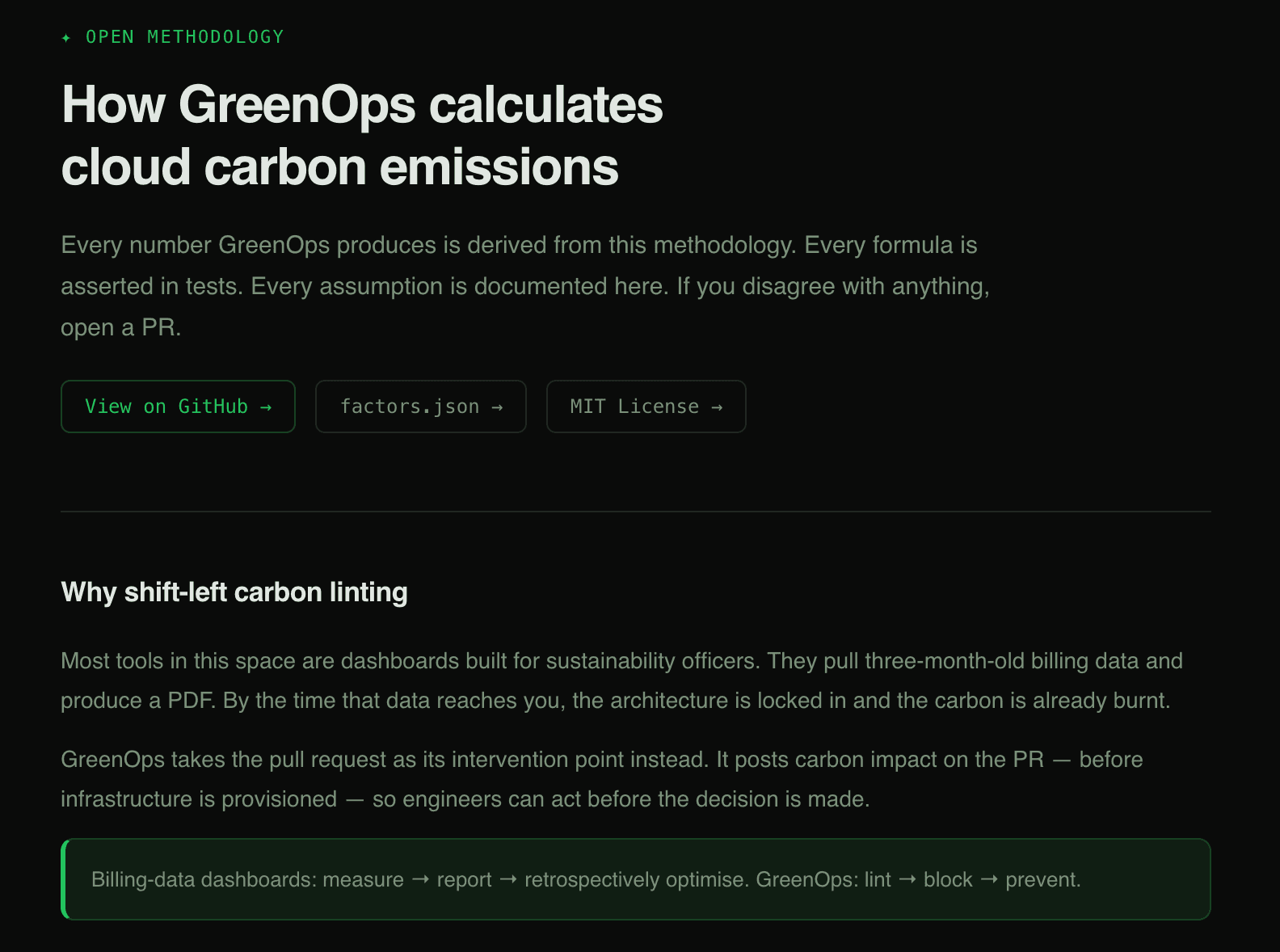
Most carbon-tooling reports emissions after infrastructure is already running, in a dashboard, for a sustainability team to review weeks later, by which point the decision is already made. greenops-cli takes the shift-left approach instead: the same logic already proven for cost (Infracost) and security (pre-merge scanning), applied to carbon.
greenops-cli reads a Terraform plan directly, computes Scope 2 (operational) and Scope 3 (embodied) carbon plus water impact per resource against the Cloud Carbon Footprint methodology, and posts the result, including ARM-upgrade and region-shift recommendations, as a PR comment. Its specific focus is AI/GPU infrastructure, GPU instances, SageMaker, Vertex AI Workbench, modelled from real NVIDIA TDP specs, with embodied carbon honestly flagged as not-yet-modeled where no credible public baseline exists, rather than estimated from a CPU baseline.
Refusal to Estimate What It Doesn't Know
59 instance types across AWS, Azure, and GCP are modelled in an open, sourced methodology ledger, including GPU instances (real NVIDIA TDP specs) and managed AI services like SageMaker and Vertex AI Workbench. A dedicated PR-comment section, AI Infrastructure Carbon Impact, surfaces GPU and managed-AI cost and carbon to the engineer at the exact moment they decide whether to provision it.
The governing discipline is a refusal to guess: when an instance type or embodied-carbon figure isn't in the methodology ledger, the tool reports it as explicitly not-yet-modelled rather than approximating from a baseline that wouldn't apply. A wrong number is worse than no number, and every estimate in the tool is held to that standard.
Container orchestration (EKS, AKS, GKE node groups) is supported across all three major providers. 155 automated tests. 26 published npm releases. Verified end to end against a real, non-fixture Terraform plan and a real production ingest endpoint, not just unit tests.
The Same Data, Made Visible
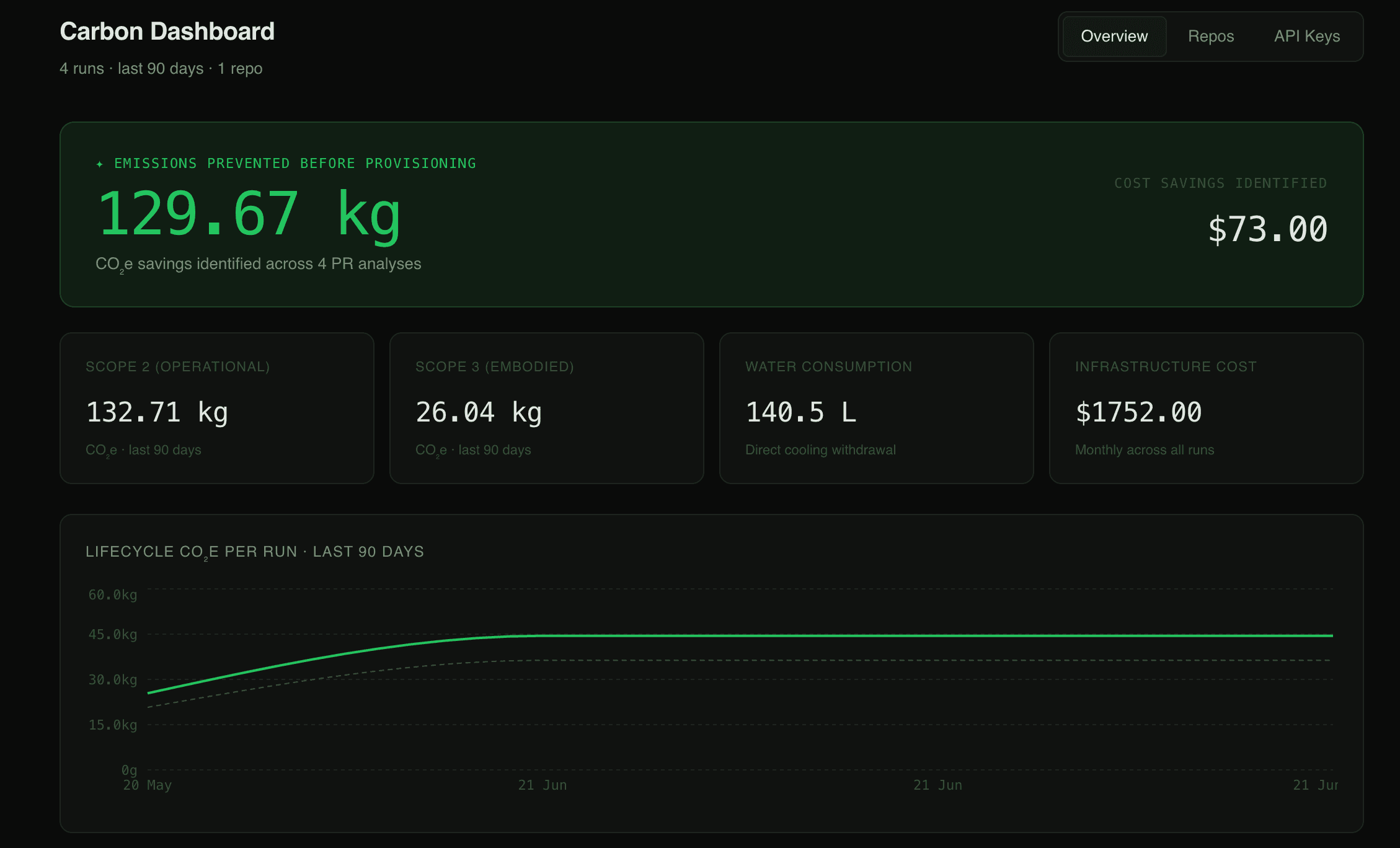
GreenOps Dashboard is the SaaS counterpart that ingests every CI run across an organisation's repositories and turns it into something a team can actually look at: historical trend lines, a per-run resource breakdown, and an Overview hero metric, Emissions prevented before provisioning, aggregating the potential CO2e and cost savings already identified across the last 90 days of PR analyses.
Built on Next.js 16, React 19, Clerk for auth, Supabase (Postgres with Row Level Security) for storage, and Recharts for visualisation. API keys are hashed and never stored raw. A real, cross-system data-integrity bug, Kubernetes node counts arriving correctly from the CLI but with no column in the dashboard schema to display them, was found through a genuine end-to-end test against production, not by either codebase's own unit tests, which by construction couldn't see a bug living in the contract between two systems.
Critical-severity auth-bypass and middleware CVEs surfaced by a routine `npm audit` were patched the same week they were found, in production, not left for a future release.
Open Source, Independently Verifiable
MIT-licensed, published on npm as `greenops-cli`, distributed as a GitHub Action. Anyone evaluating this project doesn't need to trust a claim: the package is public, the source is public, and the methodology ledger that backs every number is public too.
Built and maintained solo, with every release tagged, tested, and verified against real infrastructure before being called done.