
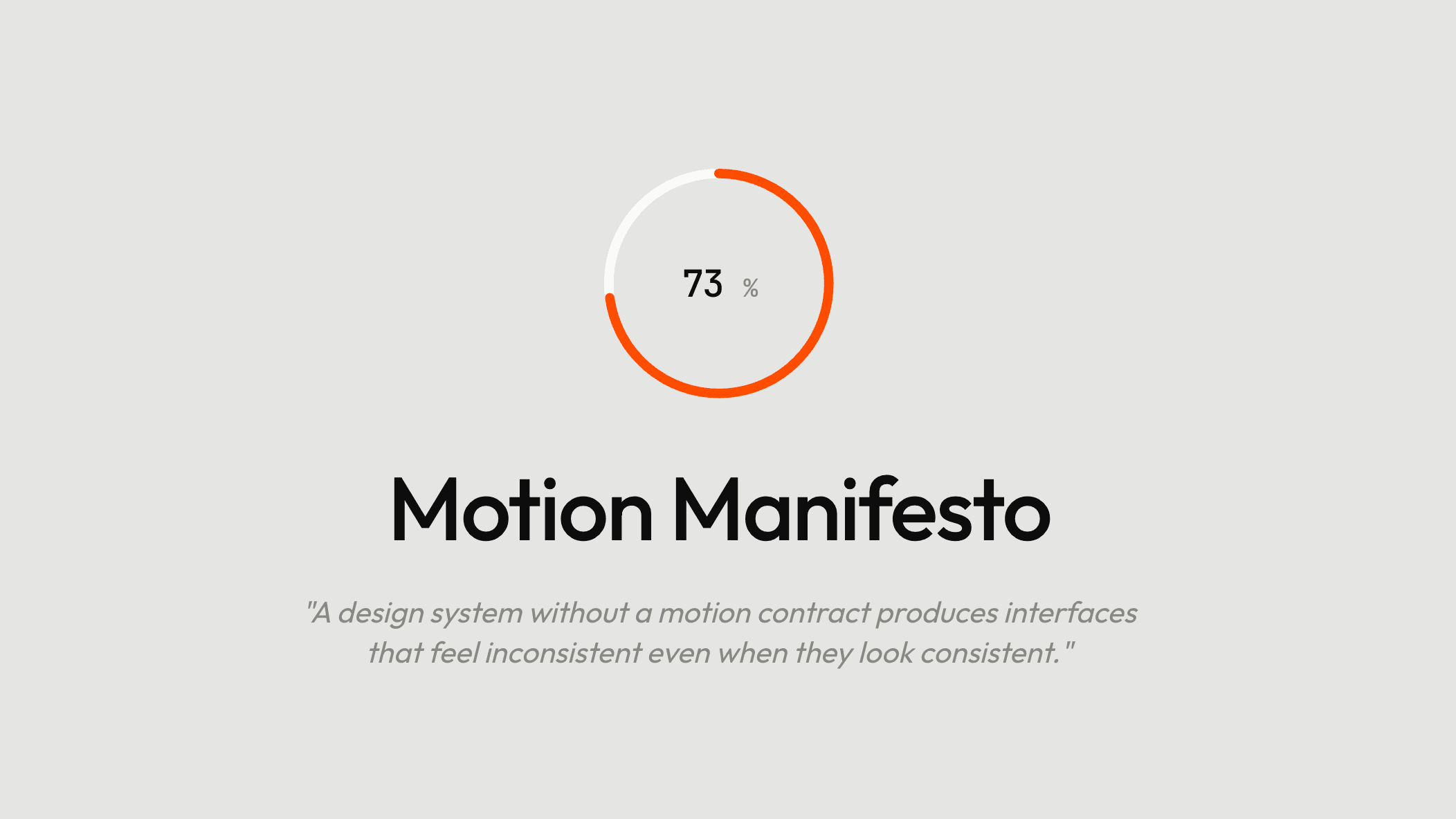
Intentional Motion
Most product interfaces have a motion language by accident. Animations layered in component by component until the product moves but doesn't feel like anything. Motion Manifesto is the alternative: a production-quality interactive reference built to prove that intentional motion is a design system concern, not an afterthought.
Livemotionmanifesto.co.uk/The Six Primitives
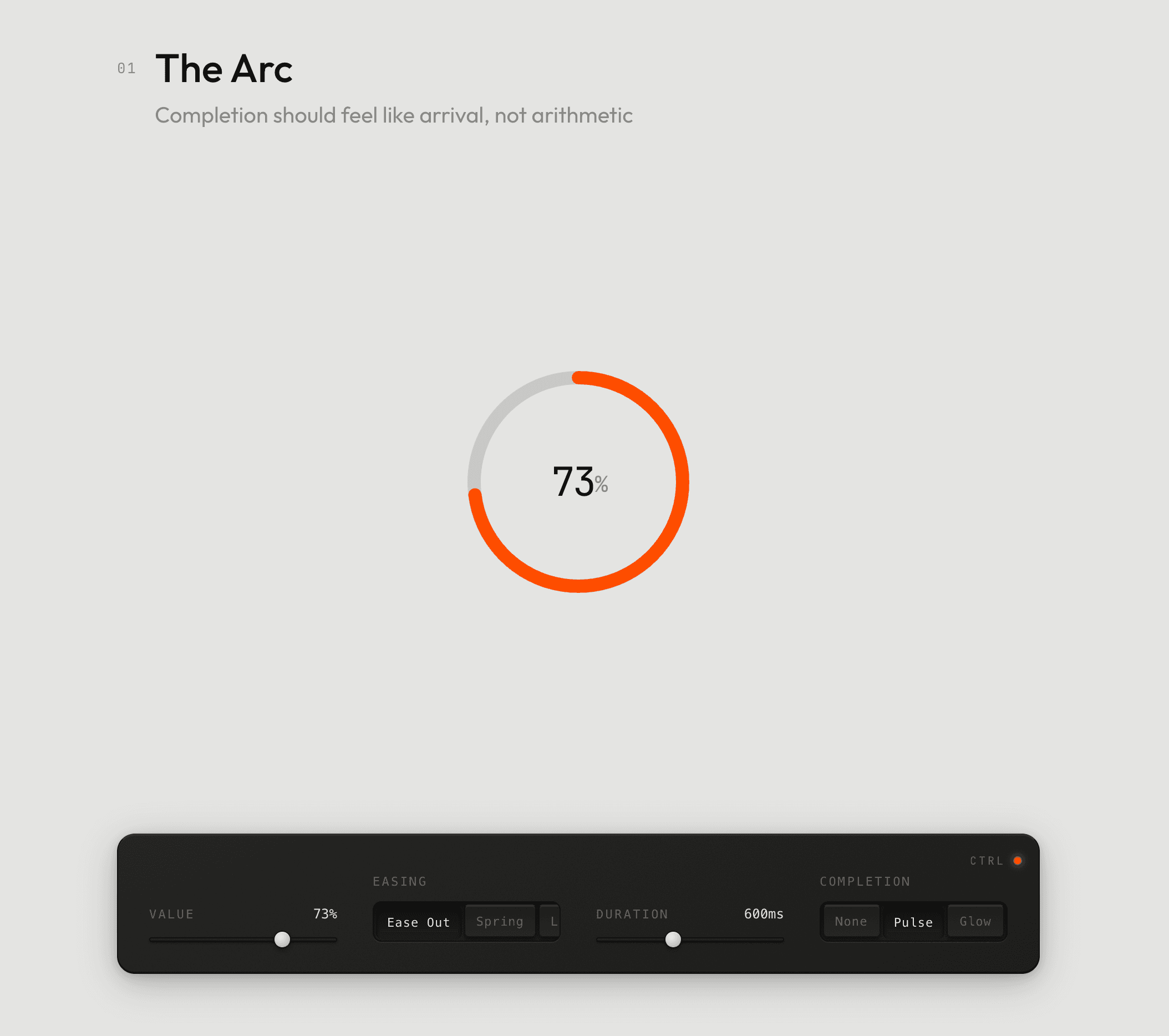
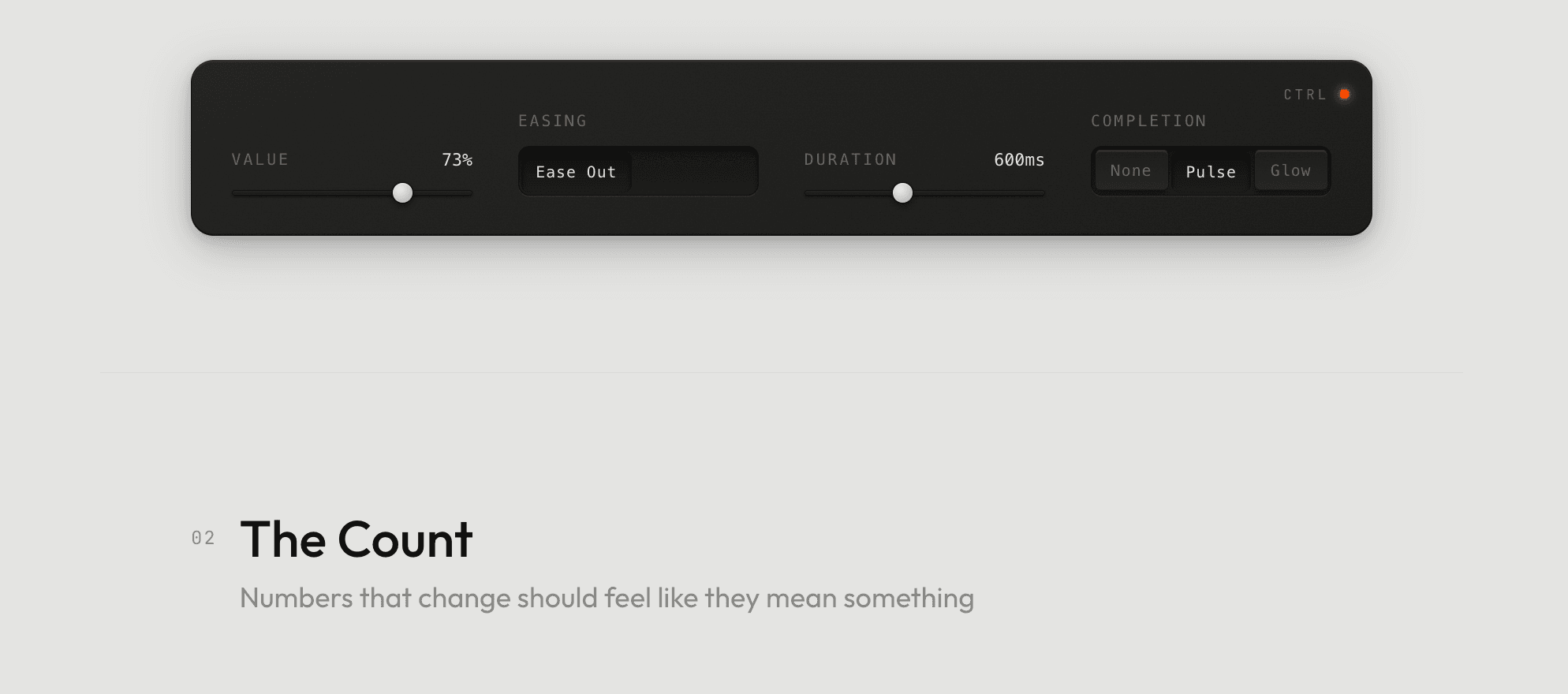
The heart of the manifesto is the pairing of a primitive with a named principle: The Arc (Completion is arrival, not arithmetic), The Count (Numbers must feel like they mean something), The Reveal (Entering a space must be considered), The State (A component that cannot communicate its condition is broken), The Nudge (Attention should be earned), and The Sequence (Orchestration creates hierarchy).
This shared vocabulary replaces subjective motion debates with a tested implementation. When a team discusses whether a notification should slide or fade, the answer is no longer a matter of opinion. It's a motion contract defined by the primitive's role in the system.
Dual-Export Segregation
The implementation is fully documented through architectural constraints, protecting Interaction to Next Paint (INP) via a strict dual-export system. We segregated a high-frequency SaaS baseline (pure Framer Motion) from our cinematic Marketing export (GSAP) to prevent bundle bloat.
This explicit boundary acts as a compiler-enforced contract. It mathematically blocks heavy animation primitives from polluting the main thread of data-dense applications while preserving high-fidelity orchestration for campaign environments.
Not Just a Reference — A Published, Load-Bearing Package
The system this site documents is @grafikui/motion, a real, versioned, MIT-licensed package — installable by anyone (npm i @grafikui/motion), source public at github.com/omrdev1/grafikui-motion, not a private internal build. Four real projects run on it in production today: grafikui.com itself, Comprent's compliance dashboard, Blocinsights, and the MOD-15 showcase.
The SaaS baseline (pure Framer Motion, zero GSAP) is the real motion layer behind Comprent and Blocinsights. The marketing baseline re-exports GSAP for cinematic orchestration work. grafikui.com consumes the shared token layer directly — the same duration and easing values documented here, not a separate one-off per page.
The dual-export boundary isn't a theoretical constraint described for the sake of the manifesto. It's enforced because a real SaaS dashboard, Comprent's, cannot afford GSAP's main-thread cost, and cinematic marketing work needs it. Every primitive demonstrated here is the same code running in client work, not a separate showcase build.
A Point of View, Shipped as Infrastructure
Motion Manifesto demonstrates what a mature motion system looks like at the component level — and unlike most design-system manifestos, it isn't just a point of view: it's a real, published library other teams can install and run, with our own studio work as the first, honest proof it holds up under production use.
Full accessibility: useReducedMotion() is respected across all primitives. Durations collapse to zero, springs are removed, and error shakes are suppressed, ensuring the motion language remains inclusive and performant for all users.
During a technical interview process with Multiverse, the manifesto came up. The interviewer's comment: this is the gold standard for motion documentation. That is the standard it was built to.
Motion Manifesto is the public proof of that methodology — and @grafikui/motion is now the shipped, installable result of it.